
Malic Acid Mischief: What Is Flavor?
Ninth Circuit Melts Motion to Dismiss

Does the hypothetical reasonable consumer distinguish between flavor ingredients and flavor enhancers? Does she distinguish between L-malate and D-malate when evaluating label claims that fruit-flavored licorice is "naturally flavored" and "free of artificial flavors?" According to the U.S. Court of Appeals for the Ninth Circuit, the plausible answers at a lawsuit's pleading stage are "no" and "yes," respectively, suggesting that the hypothetical consumer is not familiar with food regulations but has at least a fair understanding of optical isomers. Readers who are unfamiliar with the allegations behind consumer class action cases in the food and beverage space might rightfully wonder if these are really the issues occupying the federal courts, but those engaged in avoiding, defending, or even bringing them will without difficulty recognize the scenario.
Malic acid (and its chemical cousins tartaric, succinic and fumaric acid) is a widely used food additive. Sometimes called "apple acid" because it was first isolated from the juice of unripe apples, malic acid is widely used as an acidulant in food. Similar to citric acid, it imparts a familiar bite or tang but is described as being mellower and longer-lasting, making it a good choice for hard candies. Also, like citric acid, the malic acid typically used as a food additive is chemically synthesized instead of being extracted from fruit. And therein begins the saga of Trammell v. KLN Enterprises, Inc., 2026 WL 1356403, No. 24-6097 (9th Cir. May 15, 2026), because malic acid is what's known as a "chiral molecule," meaning in lay terms that it comes in a left-handed and right-handed version, which are chemically identical (C4H6O5) but not superimposable. To illustrate, place your hands one on top of the other with both palms facing down (or up): Even though they are in a sense identical (and symmetrical), they are not superimposable. But unlike hands, which come in left and right, malic acid as found in nature comes only in the left-handed form, known as L-malic acid. The synthetic process, by contrast, produces a roughly equal mixture of L-malic acid and the right-handed form (known as D-malic acid). Thus, because D-malic acid does not exist in nature, its presence in a sample indicates a synthetic origin.
With a crash course in optical isomers out of the way, we return to Trammell v. KLN Enterprises, which concerned the defendant's Wiley Wallaby brand "Very Berry" licorice, pictured here:
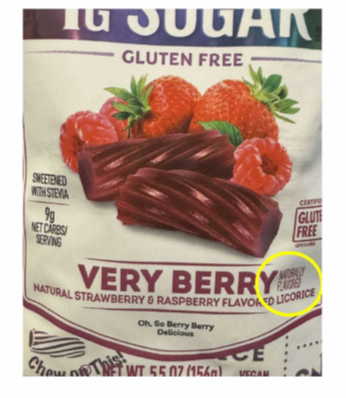
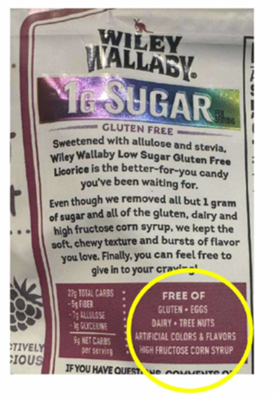
The plaintiff, suing individually and as the representative of a putative class of similarly situated consumers, alleged in part that statements on the label – "Naturally Flavored" and "Free of Artificial Flavors" – were false and misleading because the candy contained an artificial flavor, i.e., synthetically produced malic acid. This claim can be parsed as 1) malic acid is a flavor, and 2) synthetically produced malic acid is not natural. In his complaint, the plaintiff alleged that a lab had tested the product and detected D-malic acid (a chemical fingerprint of synthetic origin).
The district court granted the defendant's motion to dismiss for failure to plead with particularity, Fed. R. Civ. P. 9(b), and failure to state a claim, Fed. R. Civ. P. 12(b)(6). As to the first, it held that the complaint did not plead with sufficient particularity that the malic acid in the licorice was artificial. With respect to the second, it held that the complaint failed to plausibly allege that a reasonable consumer would be misled by the label. The plaintiff appealed, and the Ninth Circuit reversed, finding that the district court erred on both points.
With respect to the adequacy of the allegations that the malic acid in the defendant's product was artificial, the court observed that the complaint specified each of the "who," "what," "when," "where" and "how" of the alleged consumer fraud:
The allegations set out: the "who" of the fraud (KLN); the "what" (KLN's representation that its Product is free of artificial colors and flavors); the "when" (around the time Trammell purchased the Product in May 2023); the "where" (the purchase occurred at a [big box retailer] in Encinitas, California); and the "how" (the statements on the Product's label represented that the Product is "Naturally Flavored," "Natural Strawberry & Raspberry Flavored Licorice," and "Free of … Artificial Colors & Flavors"). Trammell also explained "what is false about the statement" and "why it is false" (namely, that the Product, contrary to its labeling, contains an artificial flavor in the form of DL malic acid).
Slip op. at 8
It rejected KLN's argument that the allegations were not sufficiently particularized with respect to the methodology used by the lab and how the testing was conducted, pointing out that the complaint identified the name and location of the lab, stated its qualifications, provided the date of the testing and discussed its "industry standard" methodology. Thus, the complaint gave KLN notice of "what Trammell's specific claims are, what it should defend against, and what it should seek to refute. With the details of the laboratory testing provided, Defendant could also conduct targeted discovery to test the validity of Trammell's factual claims." Id. at 8-9.
Perhaps of greater interest were the grounds on which the Ninth Circuit rejected KLN's argument that the complaint did not plausibly allege that a reasonable consumer would likely be deceived by the above-noted statements on the label even if the product contained malic acid of synthetic origin. On this point, KLN argued in part that 1) the label made no claim that the licorice was free of all artificial ingredients, 2) no reasonable consumer would believe that "a brightly colored, shelf-stable licorice candy" would be "free of artificial ingredients" and 3) even if the malic acid was deemed to be artificial, it was not actually a flavor but merely a flavor enhancer.
The first two arguments failed together, with the court characterizing as "true but irrelevant" the district court's observation that "nowhere on the front or back label does it state that the product is 'all natural,' '100% natural,' or 'free of artificial ingredients.'" As with the point about brightly colored, shelf-stable candies generally, the plaintiff's claim was not that the label falsely claimed to have no artificial ingredients, but that it claimed to have no artificial flavors. Stated differently, the presence of other artificial ingredients did not immunize the specific claim that the product was free of artificial flavors.
The Ninth Circuit gave short shrift to KLN's argument that malic acid is a flavor enhancer and not a flavor: "Trammell has plausibly alleged that a reasonable consumer expects the Product to be free of artificial flavors and that it would be misleading to that consumer if the Product contained an artificial petroleum substrate as a flavoring – whether as a flavor itself or as a flavor enhancement." Slip op. at 13. If this explanation strikes the reader as little more than play on words by subsuming both categories under the umbrella of "flavoring," it may reflect a perception that the argument itself was too technical to be credited on a motion to dismiss standard, as suggested by the court's observation that "the question is what a reasonable consumer expects, not what a regulatory expert in the food-and-beverage industry knows." Id. at 12-13.
Conclusion
KLN's appellate brief marshaled an impressive number of cases in which similar allegations were held inadequate to overcome a motion to dismiss, but the Ninth Circuit's reversal illustrates the limits, and perhaps the unpredictability, of motions to dismiss based on the combination of the Twombly/Iqbal plausibility requirement and the reasonable consumer standard. In the context of labeling reviews for compliance and risk management purposes, it cautions against decisions that rely on nuances of terminology or regulatory definitions, even if they are accurate. It is also a reminder to consider all possible uses of multifunctional ingredients when reviewing a proposed label. Here, the function of malic acid in the defendant's licorice appears to have been as a flavor enhancer, but similar ingredients can serve more than one role. For example, citric acid can serve as both a preservative and flavoring agent, raising the possibility that a "preservative free" claim might be attacked as misleading even though the manufacturer considered it only in its flavoring role (or vice versa).
Finally, it emphasizes the ambiguity around the word "natural," which lacks a specific meaning. Here, it goes to the question of identity versus source: If a mixture of D- and L-malic acid is chemically identical to pure L-malic acid from fruit, is it natural because the chemically identical molecule exists in nature or artificial because it was made in a chemical plant and has a different handedness? And if industrial-scale fermentation becomes cost-competitive with chemical synthesis, will pure L-malic acid made by microorganisms be considered natural because it is both chemically and conformationally identical to pure L-malic acid extracted from fruit or artificial because of its "unnatural" method of production? The only sure thing is that if there is a way to interpret the word "natural" to support a class-action lawsuit, it will be recognized by creative members of the plaintiffs' bar.