
Podcast - How the Midterm Elections Could Reshape Environmental Policy
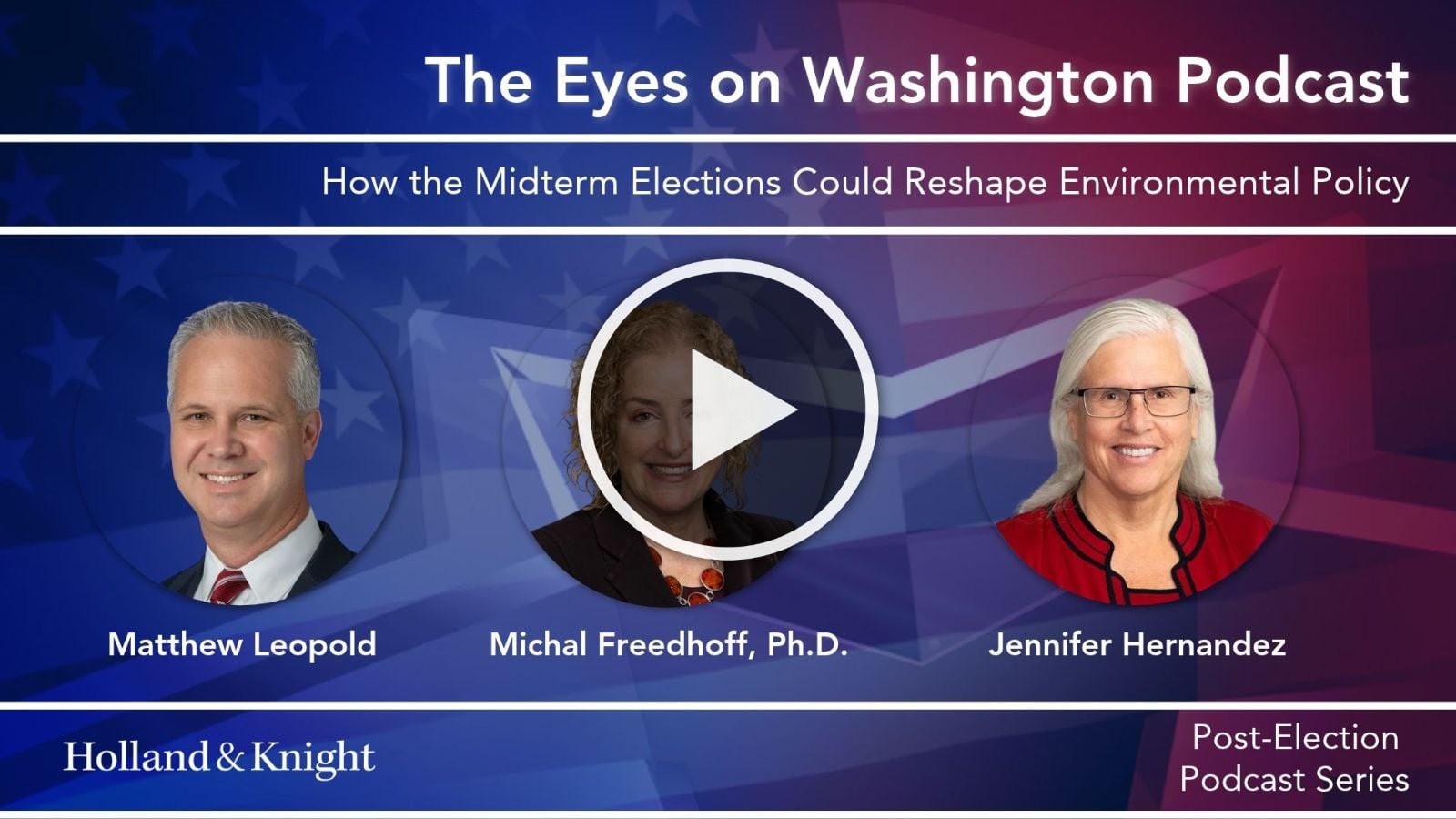
The midterm elections could significantly reshape the federal environmental policy landscape in 2027. In the first episode of Holland & Knight's "Eyes on Washington Post-Election Series," Environmental Team Co-Chair Matthew Leopold, Senior Policy Advisor Michal Freedhoff and West Coast Environmental and Land Use Group Leader Jennifer Hernandez examine how new congressional leadership could affect environmental and energy committees, oversight of federal agencies and the prospects for federal permitting reform. They also discuss the future of the U.S. Environmental Protection Agency's (EPA) regulatory agenda, growing role of litigation and state attorneys general, and competing pressures surrounding infrastructure development, climate policy and affordability.
Visit our Elections Analysis Center for the latest insights and developments.
Matthew Leopold: Hello, my name is Matt Leopold, and I'm here today to discuss the results of the midterm elections as part of Holland & Knight's midterm post-election podcast series, where we're going to explore the impacts of the election on different industries, companies and policy areas as we head into 2027 and the new Congress. I'm a partner with Holland & Knight here in Washington, D.C., in their environmental practice and formerly with EPA (U.S. Environmental Protection Agency), where I served as the general counsel of the agency. And with me, I have Michal Freedhoff and Jennifer Hernandez, who will introduce themselves.
Michal Freedhoff: Hi there. My name is Michal Freedhoff. I am a senior policy advisor here at Holland & Knight. I came to Holland & Knight pretty much directly from the EPA, where I served as the Senate-confirmed head of the chemicals office for the entirety of the Biden Administration. And before that, I spent about 20 years on Capitol Hill, both the House and the Senate side, committee and personal office, working primarily in the environmental policy space.
Jennifer Hernandez: I'm Jennifer Hernandez. I'm the California representative on this call. I lead the West Coast Environmental and Land Use Group. Environmental and land use siting and permitting is what we do, and it's very challenging. And I'm here to sort of represent both a state perspective, and a blue state at that, in this election debrief.
Matthew Leopold: Thank you both. So, Michal, I would like to start with you, and as you pointed out, you spent time on Capitol Hill before going into EPA and then joining the firm. As we look at environmental issues, could you talk a little bit about how you see things unfolding in Congress in January?
Michal Freedhoff: Sure, Matt. So, first off, I should mention that we're recording this on the afternoon of Wednesday, November 4, before all races have been called, but it's safe to say that there is a commanding majority in both the House and the Senate for the Democrats. That will mean that Democrats control the committees of jurisdiction that do work on environmental and energy issues. On the House side, there will be probably less change than on the Senate side in terms of the specific people involved because Congressman Frank Pallone from New Jersey, was the ranking member on the Energy and Commerce Committee in the last Congress, and he will become the chairman in January.
Similarly, Congressman Jared Huffman was the ranking Democrat on the House Natural Resources Committee in the last Congress, and he will become the chairman. On the Senate side, we'll be looking at Senator Heinrich from New Mexico, who will likely take the reins of the Senate Environment and Natural Resources Committee. And he led that committee for the Democrats in the last Congress, but we will see a change in the Environment and Public Works Committee on the Senate side because Senator Whitehouse is expected to become the head of the Senate Judiciary Committee. So we'll expect Senator Jeff Merkley from Oregon to become the new leader and chairman of the Senate Environment Public Works Committee.
Matthew Leopold: Great. So, in light of that and the new leadership, obviously, the priorities are going to be very different. And we know there's going to be a lot of oversight, in particular, of executive agencies. Have you been thinking about what kind of investigations the environmental committees might take up?
Michal Freedhoff: Yeah, you know, if you look at the oversight letters requesting information and documents both from the executive branch in the Trump Administration, as well as from a wide range of private sector companies, you know, you'll see a lot of these letters have already been written. And I think we'll be looking at everything from probing the connections between the past occupations of current administration officials and policy decisions that they may have made. I think we'll see a lot of looking at the Make America Healthy Again (MAHA) agenda and how those goals are described by the MAHA-adjacent groups to have not really been realized in the way that they might have hoped. And, you know, some investigating by congressional Democrats as to why particular decisions made by EPA might not have really advanced the MAHA agenda objectives.
I also think some of the various Trump Administration projects related to the golf courses, the arch, the ballroom connections and contributions that companies might have made to those efforts will be an area of focus. And I also think some of the efforts to claw back the funding in the Inflation Reduction Act that were enacted during the Biden Administration and a lot of the grant programs and loan guarantees and contracts and permits that have been rescinded or pulled back by this administration will be another strong area of focus.
Matthew Leopold: That certainly makes sense that a lot of those are coming, and we'll talk in a second about how the administration might react to a lot of those inquiries because I know they've been getting ready for it with the expected change in the House, at a minimum. And now the Senate as well will elevate that, for sure. But before we go on to the executive branch, you know, obviously, everyone's been talking about the permitting bill, also known as the Bipartisan American Affordability and Jobs Act. Any idea on the chances of passage of that in a lame-duck session? I'm thinking that might be one piece of legislation that could potentially move.
Michal Freedhoff: Yeah, I think it's sort of too soon to tell, given the results from yesterday and the fact that, you know, all the seats haven't been called yet. But I think the pointer to what to expect in the lame duck, which is those last bunch of weeks before the end of this Congress, is a really important one to consider because it's not just the permitting bill, which I agree, before the election, stood a very strong chance of enactment in this Congress. There's also a wide range of other things that touch the energy and environment space. And those include, you know, funding the government and at what levels. It includes the Farm Bill. It includes the reauthorization of the Toxic Substances Control Act fees. It includes the pesticide fees provisions as well.
And I think the question for incoming Democratic chairmen of committees of jurisdiction will be, do I want to clear the decks now and then have two years to work on advancing my own priorities and the priorities of my party, or do I want to carry some of those things over into a new Congress and potentially make some changes to what might have been a good deal before the election, might not look like as good a deal now? So, I think the jury's still out on that, but I think it's going to be a very action-packed and very busy lame-duck session.
Jennifer Hernandez: So, with respect to the view from California and the states more generally, I think it's also going to be noteworthy what isn't on the congressional agenda. There were a number of hearings, for example, around forest management, wildfire response, climate programs of various types, water management, that were fairly pointed in criticizing various California undertakings. And I just don't, obviously, see those kinds of proceedings continuing in the new Congress. And with respect to the permit reform bill, that was a compromise bill. And so, before that compromise was struck, I think the sides were pretty locked down on permit reform for me, but not thee. And the compromise is just that, a compromise. There was widespread opposition in the environmental advocacy community against permit reform, notwithstanding that compromise. And so, for me, one of the telling indications of this election outcome will be the lame-duck session's treatment of permit reform because, more than special interests of any kind, including environmental, I think the electorate spoke around affordability and wanting a more effective form of government. And so, if we devolve and take a pass on this permit reform bill and go to respective corners again, I would view that as an early loss for what the voters are hoping to achieve with a different slate.
Matthew Leopold: I agree that, you know, there seems to be broad agreement we need more infrastructure built in this country, and environmental aspects of permitting, in particular, are a huge impediment to that, whether you're building renewable energy or fossil fuel projects. But kind of turning to the administration's current agenda and focusing, particularly, on EPA and what it's been doing in regulatory reform and deregulation, frankly, my view is, one, as I mentioned, this was anticipated to some degree, and I don't know that the change in Congress is going to dramatically change the trajectory of the agency, particularly with the high-profile deregulatory efforts, like on climate regulation, particularly under the Clean Air Act. The die has been cast, and they've made their major significant proposed rules and completed a number of them already. For example, the endangerment finding has been completed and already in litigation. And the administration did that early so it could focus on defending that and, hopefully, from their perspective, getting it up to the Supreme Court. So, there will certainly be congressional oversight of EPA on climate, the endangerment finding, among other things, but I think the administration is well-prepared to defend that.
And more broadly, you now, I served in the first Trump Administration when the House of Representatives changed hands in the midterm elections and in receiving some of the incoming oversight, the agency can walk and chew gum at the same time, in my view, right? There's a function in which they're going to be responding to congressional oversight, and that does take up a lot of time and effort, but at the same time, the people who are writing the rules at the agency are generally a different group and are somewhat insulated from the back-and-forth between Congress and the agency, with certain exceptions. But I think on the priorities, you know, Administrator Zeldin's list of 50-some-odd deregulatory actions, many of them are well underway or already completed. And I think those will continue forward and, you know, it says to the extent businesses affected are listening. You know, I think you could count on those priorities being completed. As far as beyond those priorities, that's a question because there's certainly limited resources at the agency, but interested to hear what others think.
Michal Freedhoff: I generally agree with what you said, Matt, but I think that it really does absorb a great deal of agency time whenever a principal needs to go and testify before Congress. And it does divert a lot of the energy from the political team away from whatever it is that they're trying to accomplish and towards, you know, whatever defensive measures they feel they have to take based on whatever Congress is doing. But I do fully agree with you. I don't think their agenda is going to change in any way. Jennifer?
Jennifer Hernandez: Yeah, so I think that the longtime sort of catchphrase in California is the last step in the permit process is litigation. And I feel like the rulemaking process has devolved into the last step in that rulemaking is litigation, not just on the EPA side, but also on the DOI side with respect to things like endangered species or some of the habitat-related issues, public lands issues, all heading to litigation. And all of that litigation, I think, is going to consume some time and, depending on its posture, may or may not be ready for review or accepted for review by the Supreme Court. If a huge generalization about this court is permissible, I would say that this court seems disinclined to make big policy decisions that it believes Congress should be making.
And so, however that litigation tsunami continues, I suspect that Congress is going to end up having to make a new law to the extent it wants to advance new legislative priorities that aren't already solidly grounded in existing regs and precedent as it's been shaped, which includes precedent that's new around major questions around climate change and GHG (greenhouse gas). So, I think litigation is going to continue to be a very dominant feature of our rulemaking landscape at the federal level and keep uncertainty alive at the implementation level and at the state level. And that's a syndrome California has already been experiencing now for multiple years with hangover litigation, even from Trump one. So, I think continued uncertainty is an unfortunate byproduct. And frankly, the permit reform bill would help address some of that.
Matthew Leopold: Yeah, I agree totally [with you], Jennifer, on that, and I know the administration's planning to be able to, you know, file the major briefs on defense of their actions in this administration. And so, eyes will be more focused on DOJ over the last couple of years as some of the initiative shifts from the rule makers to the rule defenders. But, I mean, you kind of raised the point about litigation. Much of the litigation is really driven now by state attorneys general. And with the deepening of the Democrat control of state capitals and attorneys general offices, I think we'll see more of that. What's your thinking on how states are going to rise to fill some of the void that they've seen left by the federal government?
Jennifer Hernandez: So, I think that's a very, very interesting question because, while running against Trump and running around the broad theme of affordability were, I think, the dominant themes from yesterday, I don't think the Democratic Party has really grappled with a synthesis between affordability, adequate supply and some of the environmental priorities, especially in the climate arena. And so, I don't think that newly elected governors are simply going to, in what are now blue states, are simply going to sign on to some of the high-cost regulatory priorities that their blue colleagues have undertaken and had to either walk back or qualify or live with to some detriment.
So, I think states have, in many cases, sort of taken some of the lead in how to legislate around climate, especially. And I think that it's going to be a challenge for the newly elected crew to just do what California and New York has done and hope for better affordability outcomes. That seems unlikely. So, I think we're going to see continued uncertainty, Matt, in the litigation arena rather than a straight partisan split.
Matthew Leopold: And I think the one big case, of course, I'm watching, and you're watching, Jennifer, is the Suncor case pending at the Supreme Court, which could have major impacts on the scope of state and local authority with respect to climate regulation or allowance of these so-called climate nuisance suits. So, that's going to be a major decision coming down before June this year.
Thanks, everyone, for tuning in to our podcast series. And stay tuned for more content coming from Holland & Knight on other areas. Thank you.