
Eyes on Washington: Shutdown Briefing – Day 30
Welcome to the Eyes on Washington: Shutdown Briefing. During the federal government shutdown, we will be sharing concise, client-focused updates to help you stay informed on key developments, legislative dynamics and potential impacts to your operations and federal engagement.
Breaking News
With November 21 three weeks away, lawmakers are forced to extend the end date for legislation to keep the government open. Republican leaders are considering a continuing resolution (CR) that would stretch sometime between mid-January and March 2026.
U.S. District Judge Indira Talwani in Boston heard arguments on October 30 urging her to force the U.S. Department of Agriculture (USDA) to use $6 billion from its contingency funds to pay for Supplemental Nutrition Assistance Program (SNAP) benefits. The program costs about $8 billion monthly.
Status Update
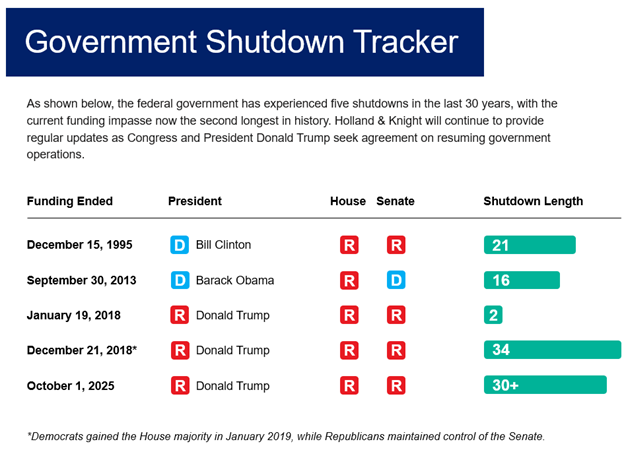
Today marks Day 30 of the federal government shutdown. Negotiations on reopening the government remain stalled.
Congressional Activity
- Democratic Leadership: On October 29, U.S. Senate Minority Leader Chuck Schumer (D-N.Y.) held a press conference at the U.S. Capitol, and U.S. House of Representatives Minority Leader Hakeem Jeffries (D-N.Y.) spoke with MSNBC. Both leaders called on Republicans to renew Affordable Care Act (ACA) subsidies and vote on a stand-alone bill to fund SNAP, and they asserted that Democrats would not vote to reopen the government without a commitment to address these issues. However, Democrats have said they're open to a proposal from Sen. Ron Johnson (R-Wis.) to pay all federal workers, as well as a bill by Sen. Josh Hawley (R-Mo.) to continue to fund SNAP.
- Republican Leadership: Continues to blame Democrats for the shutdown. Senate Majority Leader John Thune (R-S.D.) said, "There are a lot more conversations going on now" between Republicans and Democrats. He expects it to be a matter of time before rank-and-file Democrats finalize a deal. Sen. Thune is not in favor of "rifle shot" approaches to funding individual programs or departments, so the Senate is unlikely to come to a vote. He is holding the line that while all of this is important, the way to fund it all is through a CR. A stopgap measure reopening federal agencies proves critical before advancing full-year spending appropriation bills.
- Senate Activity: The Senate will consider a resolution about the National Petroleum Reserve in Alaska, as well as a Democratic measure challenging the emergency declaration used to impose tariffs around the world. In addition, for the 14th time, the Senate failed to pass the House-passed "clean CR" to end the shutdown. The House continues to convene on a pro forma basis.
Executive Branch Developments
- Presidential Engagement: President Donald Trump met with Chinese President Xi Jinping in Busan, South Korea, on October 30. The successful summit resulted in agreements by President Xi to authorize purchases of massive amounts of soybeans, sorghum, other farm products and American energy from Alaska, as well as a one-year pause on restrictions of rare earth materials and critical minerals exports and a commitment to stop the flow of fentanyl into the U.S. In return, President Trump promised to cut in half the 20 percent tariffs, bringing overall tariffs on Chinese goods down from 57 percent to about 47 percent.
- Air Travel: On October 29, the Federal Aviation Administration issued a ground stop at Newark Liberty International Airport (EWR) due to staffing shortages and the impacts of Hurricane Melissa, causing more than 2,700 flight delays. Vice President JD Vance led a roundtable on October 30 focusing on how the government shutdown is impacting air travel.
- Defense: President Trump directed the Pentagon to resume testing nuclear weapons on an equal basis to Russia and China. This move was caused largely due to a recent Russian test of nuclear-capable cruise missiles and China's buildup of about 600 warheads in its nuclear arsenal. This announcement heightened tensions around a return to an arms race
- Today Through November: The Special Supplemental Nutrition Program for Women, Infants, and Children (WIC) may begin to experience funding shortfalls.
- October 31: House staff are confirmed to miss their paychecks, but Pentagon workers will receive their paychecks. Members of Congress will continue to receive pay throughout the shutdown.
- November 1: The ACA open enrollment period begins. Participants may see premiums increase significantly. The House-passed CR does not include an extension of ACA tax credits, which are set to expire at the end of the year.
- November 4: Off-year gubernatorial elections are held in Virginia and New Jersey.
- November 5: The government shutdown will become the longest in history, beating a 35-day record set during President Trump's first term.
- November 7: Non-exempt federal employees will have worked one month without pay.
- November 15: Military members will not receive their scheduled paychecks
- Agency Engagement: Clients should anticipate delays in regulatory reviews, permitting and federal communications.
- Contracting and Grants: Federal contractors may experience payment disruptions and limited access to agency personnel.
- Policy Positioning: The shutdown may create new leverage points in legislative negotiations. Clients with interests in appropriations, healthcare, defense and infrastructure should monitor developments closely.
Key Milestones Ahead
Strategic Considerations for Clients
Contact Us
Holland & Knight will continue to provide updates throughout the shutdown. For tailored guidance or strategic briefings, please contact one of our Public Policy & Regulation Group members below.
Todd Wooten
Dimitrios J. Karakitsos
Karl R. Koch
Sara E. Peters
Dennis S. Potter
Elizabeth Leoty Craddock
Information contained in this alert is for the general education and knowledge of our readers. It is not designed to be, and should not be used as, the sole source of information when analyzing and resolving a legal problem, and it should not be substituted for legal advice, which relies on a specific factual analysis. Moreover, the laws of each jurisdiction are different and are constantly changing. This information is not intended to create, and receipt of it does not constitute, an attorney-client relationship. If you have specific questions regarding a particular fact situation, we urge you to consult the authors of this publication, your Holland & Knight representative or other competent legal counsel.