
SEC Enforcement 2026 Year in Review

As the leaves fall and the busy holiday season approaches, the SEC has once again reported its enforcement results for its fiscal year (FY), which ended September 30. FY 2026 was the first full fiscal year under Chairman Paul Atkins and, for most of the year, new Enforcement Director David Woodcock. Grab a mug of something warm while we summarize what the SEC reported (and what it did not), compare the numbers to prior years and offer a few takeaways.
Enforcement by the Numbers
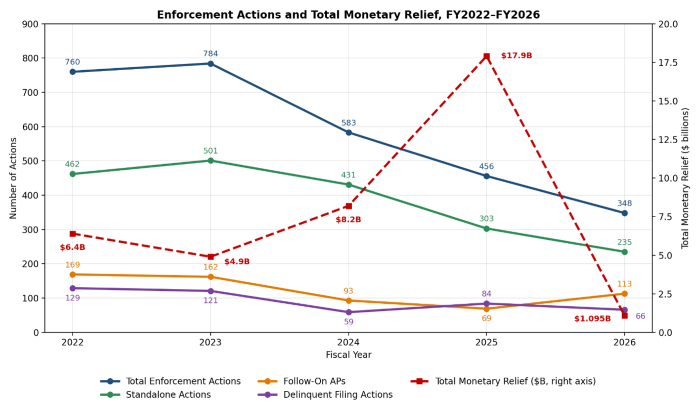
In FY 2026, the Commission filed 348 total enforcement actions, including 235 stand-alone actions and 113 follow-on administrative proceedings (APs) seeking to bar or suspend individuals based on criminal convictions, civil injunctions or other qualifying orders. The Commission also instituted 13 trading suspensions in response to suspected manipulation involving securities of Asia-based issuers.
The year-over-year comparison continues the steep downward trend we flagged in each of the last two years (see our previous reports for FY 2025 and FY 2024):
|
FY |
2026 |
2025 |
2024 |
2023 |
2022 |
|
Total enforcement actions |
348 |
456 |
583 |
784 |
760 |
|
Stand-alone actions |
235 |
303 |
431 |
501 |
462 |
|
Follow-on APs |
113 |
69 |
93 |
162 |
169 |
|
Delinquent filing actions |
66 |
84 |
59 |
121 |
129 |
|
Total monetary relief (headline) |
$1.095 billion |
$17.9 billion |
$8.2 billion |
$4.9 billion |
$6.4 billion |
|
Disgorgement and prejudgment interest (headline) |
$752 million |
$10.8 billion |
$6.1 billion |
$3.4 billion |
$2.2 billion |
|
Civil penalties (headline) |
$343 million |
$7.2 billion |
$2.1 billion |
$1.6 billion |
$4.2 billion |
A few observations:
- Total Actions Down Roughly 24 Percent. The 348 actions filed in FY 2026 represent a decrease of 108 actions (about 24 percent) from FY 2025's 456 – which was itself the lowest total in at least 20 years. Measured against FY 2024 (583), total actions are down approximately 40 percent, and against FY 2023 (784), they are down approximately 56 percent.
- Stand-Alone Actions Down Roughly 22 Percent. Stand-alone actions – generally the best barometer of new investigative output – fell from 303 to 235 (a decline of 68, or about 22 percent). That is roughly 45 percent below FY 2024 (431) and 53 percent below FY 2023 (501). In addition, according to Cornerstone Research, less than 7 percent of stand-alone enforcement actions were brought against public companies and subsidiaries, the lowest share since at least FY 2013. However, overall, stand-alone actions made up approximately two-thirds of all actions in both FY 2025 and FY 2026, meaning that the mix of actions has held relatively steady.
- Follow-On APs Bucked the Trend. Follow-on APs rose from 69 to 113, an increase of about 64 percent year over year and about 22 percent above FY 2024 (93), though still well below FY 2022 and FY 2023 levels. Because follow-on proceedings piggyback on criminal convictions and civil injunctions already obtained, this uptick is consistent with the agency's stated emphasis on individual accountability and its parallel work with criminal authorities.
- Whistleblowers Continue to Serve an Important Role. Participation in the whistleblower program remains strong: In FY 2026, the Commission received approximately 26,000 whistleblower tips and awarded more than $158 million to 65 individual whistleblowers. That is the highest number of individual whistleblowers since FY 2023 and significantly more than last year's $60 million awarded to 48 individual whistleblowers.
- The Race to the Finish Continues. As we have noted in past years, September remains the busiest month for the Enforcement Division. In FY 2026, 99 of the 348 actions – approximately 28 percent – were filed in September alone.
Monetary Remedies at a Multi-Decade Low
The SEC obtained orders for monetary relief totaling $1.095 billion in FY 2026, comprising $752 million in disgorgement and prejudgment interest and $343 million in civil penalties. Of the disgorgement ordered, $235 million was deemed satisfied by a court order in a separate non-SEC action. This is a historical low of financial remedies.
Comparing FY 2026 to FY 2025 requires some care because last year the SEC began breaking out "deemed satisfied" amounts. In addition, FY 2025 numbers include judgment from a long-running $8 billion Ponzi scheme case.
- Against FY 2025 headline figures ($17.9 billion total, $10.8 billion disgorgement and prejudgment interest, $7.2 billion penalties), FY 2026 total relief is down approximately 94 percent, and civil penalties are down approximately 95 percent.
- Against FY 2025 adjusted figures ($2.7 billion total, $1.4 billion disgorgement and prejudgment interest, $1.3 billion penalties), FY 2026 headline relief is down approximately 59 percent, disgorgement is down approximately 46 percent and civil penalties are down approximately 74 percent.
- On a closer apples-to-apples basis, excluding the $235 million deemed satisfied in FY 2026 yields approximately $860 million in total relief and $517 million in disgorgement and prejudgment interest – roughly 68 percent and 63 percent below the FY 2025 adjusted totals, respectively.
Another noteworthy number: The SEC reported returning approximately $731 million to more than 250,000 harmed investors in FY 2026, roughly 2.8 times the approximately $262 million returned in FY 2025. That metric aligns with the current Commission's stated preference for measuring success by investor recovery rather than headline penalties. Chairman Atkins has emphasized that "[e]nforcement actions and financial remedies are important measures of activity, but they are not the only or most telling measures."
Individual Accountability
Two-thirds of all stand-alone actions filed in FY 2026 included charges against at least one individual. That figure is essentially unchanged from FY 2025, when approximately two-thirds of stand-alone actions involved individual charges (itself a 27 percent year-over-year increase). Notably, last year the SEC reported that nearly nine of every 10 stand-alone actions filed under Acting Chair Mark Uyeda, then Chairman Atkins, involved individual charges; with FY 2026 being the first full year under current leadership, the two-thirds figure suggests the rate of individual charging has leveled off rather than continued to climb. Combined with the 64 percent jump in follow-on APs, however, the message remains clear: Individuals continue to face meaningful personal exposure.
What the SEC Did Not Report
As in prior years, it is worth noting what was absent from the headline release. Last year, the SEC reported a record 53,753 tips, complaints and referrals, 119 officer-and-director bars, and 1,095 closed investigations. The SEC has not provided comparable FY 2026 figures. In particular, we continue to believe that publicly reporting the number of investigations closed without action – which the SEC did for the first time last year – provides valuable context, and we hope it becomes a regular feature.
Organizational and Policy Changes
Although our focus is the numbers, the FY 2026 release devoted considerable attention to structural changes that may drive future statistics:
- New Units. The Division formed a Retail Fraud Working Group (which the SEC reports has already generated more than a dozen new investigations), a Financial Reporting and Accounting Unit, and an Office of Super Intelligence and Analytics, plus reorganized its Trial Unit.
- Enforcement Manual and Wells Process. The Division updated the Enforcement Manual for the first time since 2017, standardizing the Wells process, allowing simultaneous consideration of settlement offers and waiver requests, and explaining its framework for crediting cooperation, including its impact on civil penalties. The Division will review the Manual annually going forward.
- "No-Deny" Policy Rescinded. The Commission rescinded Rule 202.5(e), its long-standing policy that settling parties may not publicly deny the allegations against them. Cornerstone Research reports that in FY 2026, not a single defendant in a public company and subsidiary action had an admission of guilt. The last time that happened was FY 2021.
In addition, according to Cornerstone Research, FY 2026 is the first fiscal year without any actions initiated against public companies or subsidiaries under the Foreign Corrupt Practices Act (FCPA). That development reflects a policy change following an executive order issued by the White House on February 10, 2025, pausing FCPA enforcement by the U.S. Department of Justice.
Wrapping Up 2026, Looking Toward 2027
FY 2026 confirms that the decline in enforcement volume and remedies observed in FY 2025 was not merely a transition-year anomaly. Total actions, stand-alone actions and monetary relief all fell again while follow-on proceedings and investor distributions rose. The Commission frames these results as the product of a deliberate "quality over quantity" approach focused on fraud and individual accountability. Whether the Division's new units, technology investments and targeted hiring translate into higher case counts in FY 2027 remains to be seen. In the meantime, market participants can seek to take advantage of the revised Wells process and the Division's articulated cooperation framework while expecting continued scrutiny of individuals. Stick with SECond Opinions, refill that cocoa, and we will keep watching together.
Holland & Knight's Securities Enforcement Defense Team will continue to monitor developments. For more information or questions, please contact the authors.