
EPA Boosts Biofuel Mandates in Final Renewable Fuel Standard Rule for 2026-2027
Highlights
- The U.S. Environmental Protection Agency (EPA) has finalized a rule setting record-high levels for U.S. blending of biofuels.
- EPA estimates the rule will require a 60 percent increase of biodiesel and renewable diesel production and use compared to 2025 levels.
- This Holland & Knight alert summarizes policy changes in the final rule and their expected impact in the energy, agricultural and manufacturing sectors.
The U.S. Environmental Protection Agency (EPA) on March 27, 2026, finalized its rule establishing Renewable Fuel Standard (RFS) Renewable Volume Obligations (RVOs) for 2026 and 2027. This rule, also known as "Set 2," establishes a multiyear mandate for biofuels blending in the U.S. transportation fuel supply, increasing volumes from both the previous mandate and proposed rule released in June 2025. The final rule was announced by President Donald Trump at the White House during a celebration of American agriculture.
The final rule was published in the Federal Register on April 1, 2026, and will take effect June 15, 2026. Upon publishing, EPA touted the rule in press outreach as a boon to the biofuels industry and rural America, with a particular emphasis on renewed demand for domestic soybean production. The agency estimated the rule will require a 60 percent increase of biodiesel and renewable diesel production and use compared to 2025 levels. It also estimated the rule will generate more than $10 billion for rural economies and create more than 100,000 new jobs in the agricultural and manufacturing sectors.
In addition to the volume standards, the rule makes a number of policy changes to the RFS program's implementation. This Holland & Knight alert analyzes and summarizes the RVOs and policy changes, as well as their expected impacts.
Volume Standards
Reaching record-high levels, the final RVOs compared to proposed volumes are identified in the chart below. These volumes are inclusive of reallocating prior year volumes exempted via Small Refinery Exemptions (SREs), which were retroactively granted following litigation. They are also inclusive of updated 2025 cellulosic biofuel volumes following finalization of a partial waiver. All of the volumes for 2026 and 2027 are slightly higher than the proposal.
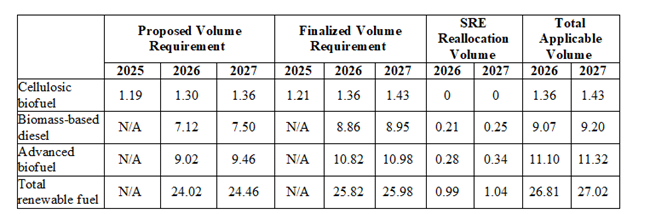
2026 and 2027 Renewable Fuel Volume Requirements, SRE Reallocation Volumes and Total Applicable Volumes (billion Renewable Identification Numbers (RINs))
Overall, the volumes maintain an implied conventional biofuel volume requirement of 15 billion gallons annually, recognizing the mandate will be partially achieved through use of additional volumes of advanced biofuel (D5) RINs beyond the D5 mandate. The rule further recognizes significant growth in the advanced and biomass-based diesel (BBD) sectors and future projected growth in domestic production, especially in soybean oil-based fuel.
SRE Reallocation
In September 2025, EPA released a supplemental proposed rule to account for recent decisions on SRE petitions. Building on this proposal, EPA finalized in this rule a partial reallocation of the 2023-2025 SRE exempted volumes, citing the need to balance protecting biofuel demand while maintaining a stable and functioning credit market. The total reallocation is 70 percent of the total exempted volumes for the 2026 and 2027 compliance years. Some older volumes have also been exempted and not accounted for at all in the reallocation.
Imported RINs
EPA's proposed rule included an "imported RIN reduction" (IRR) provision, which would have reduced by 50 percent the RIN credits for finished imported biofuels and domestic biofuels made from imported feedstocks. In this rule, EPA chose not to finalize this proposal for 2026 and 2027. The rule states that though EPA believes the proposal remains "appropriate" and "aligned with statute," more time is necessary to successfully establish and implement such a provision. EPA instead announced it intends to establish IRR provisions that will take effect beginning in the 2028 compliance year or shortly thereafter. At this time, there does not appear to be any intent to establish an IRR exemption for fuel or feedstock from Canada or Mexico.
Cellulosic Biofuel Requirements
This rule finalizes a partial waiver of the 2025 cellulosic biofuel mandate and revises the associated percentage standard due to a 170 million-gallon RIN shortfall. The waiver reduces the mandate from 1.38 billion RINs to 1.21 billion RINs and makes cellulosic waiver credits (CWCs) available for the 2025 compliance year.
eRINs
Since the 2012 RFS2 Rule, EPA has afforded the possibility of a pathway for renewable electricity to participate in the RFS program. "eRINs" were intended to support biogas used to generate renewable electricity, then in turn used in an electric vehicle (EV). However, no eRINs have been successfully generated under the RFS program to date. Aligning with the Trump Administration's rollback of EPA regulations that support EVs, the final RVO rule affirmatively removes the possibility of approving pathways for and generating eRINs.
The elimination of eRIN pathways was included in the proposed RVO. The final rule updates EPA's statutory justification for finding renewable electricity does not qualify as renewable fuel, focusing on a plain language interpretation of the underlying Clean Air Act section 211(o)(1)(J), which mentions liquid or gaseous fuels only. In the final rule, EPA affirms electricity is not "fungible with fossil fuel that is present in a motor vehicle," "cannot replace or reduce a volume of fossil fuel that is present in a motor vehicle or motor vehicle engine" and, therefore, "does not meet the statutory definition of renewable fuel."
This represents an expected reversal of the EPA's determination established in the 2012 RFS2 Rule and is based on a stricter statutory interpretation, citing the U.S. Supreme Court's 2024 reversal of the Chevron doctrine.
Electricity Generation
EPA's final rule includes a new prohibition on RIN generation for fuel that is used for process heat or electricity generation, except as specified in 40 C.F.R. 80.1426(f)(12). Citing a desire to ensure that renewable fuel producers do not generate RINs for renewable fuel used for process heat or electricity generation, EPA had included in its proposal a change to the definition of "heating oil" to state that pure biodiesel (i.e., B100) or neat biodiesel (i.e., B99) used for process heat or power generation is not "heating oil." EPA agreed with commenters that blends of biodiesel above B80 fall under the definition of "heating oil" and, therefore, it makes little sense to distinguish blends above B80. Furthermore, EPA expanded the prohibition to all renewable fuels to firmly clarify that process heat and electricity generation are not qualifying uses for the RFS program, regardless of type of fuel.
Biogas
The rule finalizes several changes to the RFS program's biogas regulations. It clarifies and provides flexibility for how biogas, renewable natural gas (RNG), and renewable compressional natural gas and liquefied natural gas (CNG and LNG) are measured, sampled and tested to demonstrate compliance. Furthermore, technical amendments to the biogas regulations clarify:
- what constitutes a batch of RNG
- the requirements for the generation, assignment and separation of RINs for RNG
- the registration requirements for biogas producers, RNG producers and RNG RIN separators
- the attest engagement requirements for biogas producers, RNG producers and RNG RIN separators
Of particular note, the rule states that any time a party transfers an assigned RIN with a K code of 3, it is deemed to have transferred a corresponding physical volume of RNG. This seems to be intended to clarify EPA's support for book and claim accounting. On the other hand, EPA added a prohibited act that states that recipients of K3 RINs must receive a corresponding volume of RNG. EPA stated in the preamble that this volume "need not be the same volume used for RIN generation" but reiterated the need to obtain physical volumes. These additions appear somewhat inconsistent, and parties should work with counsel to determine how best to ensure compliance.
Renewable Diesel, Naphtha and Jet Fuel Equivalence Values
The rule finalizes several changes to equivalence values for renewable diesel, naphtha and jet fuel. The values for renewable diesel and jet fuel are lowered from EPA's previous proposal to account for the nonrenewable portion of these fuels typically produced using a hydrotreating process.
|
|
Proposed |
Final |
|
Renewable Diesel |
1.6 (down from 1.7) |
1.5 (down from 1.7) |
|
Renewable Jet Fuel |
1.6 |
1.5 |
|
Naphtha |
1.4 |
1.4 |
In these applications, renewable diesel producers may use the average renewable content for renewable diesel estimated for this action (93.9 percent) or provide justification for an alternative renewable content. Renewable diesel producers that choose to base their application on the average renewable content will need to submit only testing results of the energy content of their renewable diesel in their application.
Recognizing potential complications associated with changing equivalence values in the middle of a compliance year, EPA delayed compliance until January 1, 2027, for these provisions instead of the June 15, 2026, effective date for the rest of the rule.
BBD Standard in RINs Versus Gallons
EPA proposed in this RVO to change the BBD volume requirement from gallons, which was previously required by statute to RINs. Previously, BBD was the only category whose volume requirement was physical gallons rather than RINs. Contextually, the 2025 mandate was 3.35 billion physical gallons.
This rulemaking finalizes that shift by establishing 2026 and 2027 BBD applicable volumes of 9.07 and 9.20 billion RINs, respectively. Though these volumes guarantee that at least 5.33 billion and 5.75 billion gallons of BBD will be used in 2026 and 2027, respectively, this represents a shift in EPA's approach to equivalence. In justifying the change, EPA cites a desire to reduce confusion among stakeholders regarding how to interpret the volume requirement and how the BBD percentage standard is calculated, while noting there is no practical effect on regulated parties.
Definitions
This rule finalizes new definitions for terms included but not defined in previous RFS regulations. These terms are defined as follows:
- Renewable Fuel Producer. Any person who owns, leases, operates, controls or supervises a facility where renewable fuels are produced
- Renewable Fuel Oil. Heating oil that is renewable fuel and that meets the paragraph 2 of the definition of "heating oil"
- Renewable Naphtha. Naphtha that is renewable fuel
- Renewable Jet Fuel. Jet fuel that is renewable and meets the standard for conventional jet fuel, ASTM D1655 or specification for aviation turbine fuel containing synthesized hydrocarbons, ASTM D7566
This rule updates definitions related to imported biofuels specifically to clarify which entities qualify as foreign renewable fuel producers or importers. One clarification addresses foreign biogas and RNG production, now defining a foreign renewable fuel producer as "any person that owns, leases, operates, controls, or supervises a facility outside the covered location where renewable fuel is produced." A second clarification expands the definition of importer to include "the importer of record or an authorized agent acting on their behalf, as well as the actual owner, the consignee, or the transferee, if the right to withdraw merchandise from a bonded warehouse has been transferred." Third, the liability provisions are expanded to specify that each person meeting the definition of an importer of renewable fuel under the RFS regulations is jointly and severally liable for any violations of the RFS requirements, including the new import RIN reduction provisions that allow EPA to hold importers fully liable.
Finally, this rule confirms the addition of two new biointermediates as eligible to produce qualifying renewable fuels: activated sludge and converted oils, requested in petitions in 2023 and 2024, respectively. "Activated sludge" is defined as waste sludge from a secondary wastewater treatment process involving oxygen and microorganisms. "Converted oils" are defined as glycerides such as monoglycerides and diglycerides that are produced through the glycerolysis of waste oils, fats or greases with glycerol.
Other Potential Future Actions
In its proposal, EPA requested comments on several additional topics that remain unaddressed in this rulemaking. In its final rule, EPA commits to consideration of potential ways to address these areas in future actions:
- a general pathway for the production of renewable jet fuel from corn ethanol
- the definition of "produced from renewable biomass"
- RFS program amendments to ensure that imported renewable fuels are produced from qualifying feedstocks and enhance EPA's ability to track feedstocks to their point of origin
- RFS program enhancements to increase the use of qualifying woody-biomass to produce renewable transportation fuel
- definitions for different types of woody biomass, noting EPA may consider modifications to relevant definitions such as "areas at risk of wildfire," "slash," "pre-commercial thinnings" and "tree residue"
In addition to the topics addressed above, the rule includes a number of additional technical changes to RFS implementation addressing issues such as percentage standard equations, renewable fuel pathways, compliance reporting and recordkeeping, as well as registration and compliance reporting deadlines and more.
Next Steps
Challenges to the final rule must be filed within 60 days. RFS final rules are invariably challenged, and SRE reallocations are expected to be one of the most divisive topics with petitioners bringing suit on both sides of the issue. Such litigation typically takes at least 18 to 24 months and can move especially slow if multiple topics are consolidated into one case. EPA does state in the preamble that several areas can be severed, meaning that a court could determine that certain issues are heard as stand-alone cases.
For additional information, please contact the authors.
Information contained in this alert is for the general education and knowledge of our readers. It is not designed to be, and should not be used as, the sole source of information when analyzing and resolving a legal problem, and it should not be substituted for legal advice, which relies on a specific factual analysis. Moreover, the laws of each jurisdiction are different and are constantly changing. This information is not intended to create, and receipt of it does not constitute, an attorney-client relationship. If you have specific questions regarding a particular fact situation, we urge you to consult the authors of this publication, your Holland & Knight representative or other competent legal counsel.